I thought, quite egocentrically, that if you had inherited it,
then I probably wouldn’t have it after all.
Enlarged
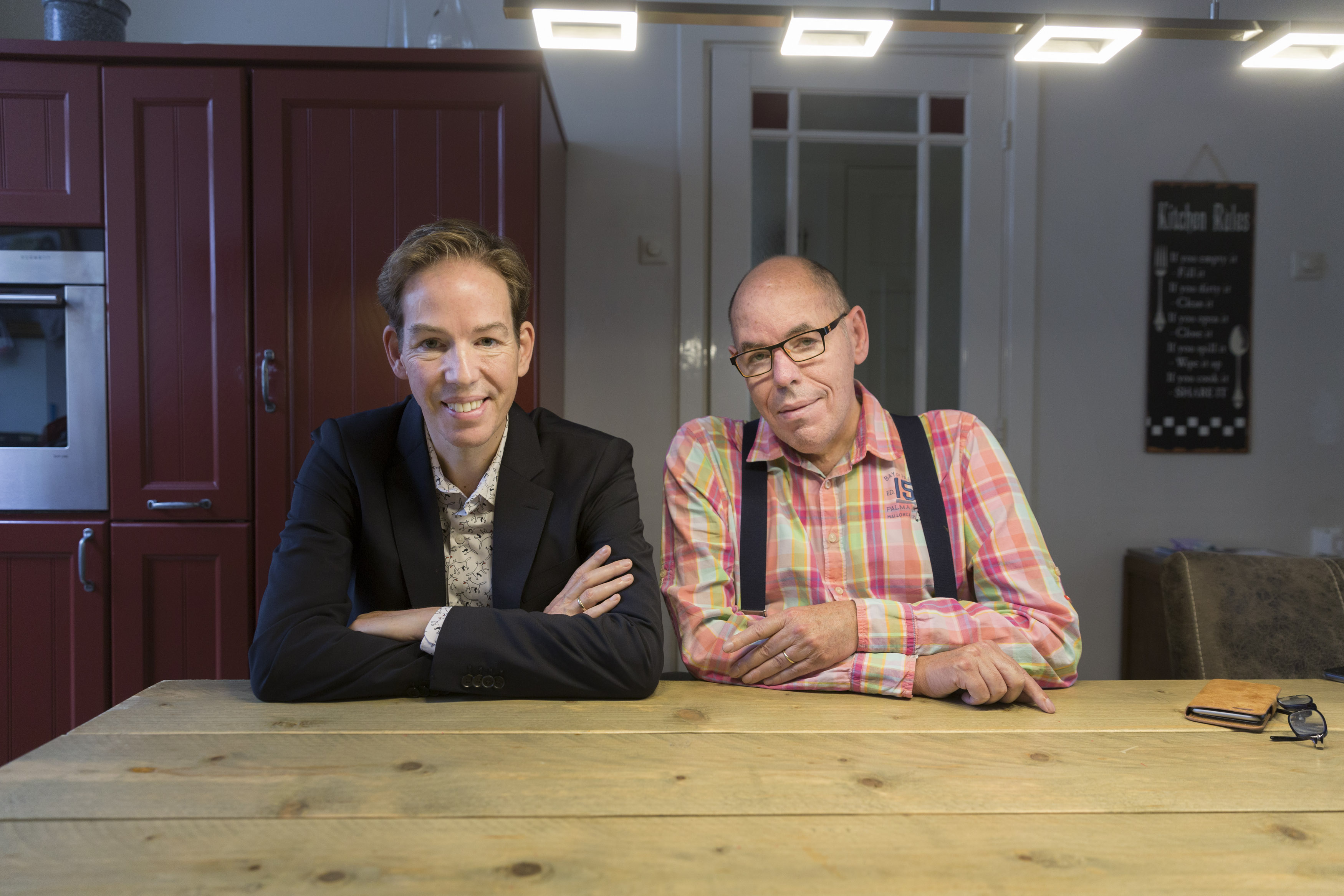
Edwin Roovers
[translated]
Dear Edwin,
I still often miss your sweet greeting, “little brother!” The diminutive was kind of funny: at 1.92m, I towered well above you.
As a student, you made up for your height with a broad torso, muscular shoulders and a generous smile — quite a catch! Those muscles you got from my father, also a big guy (“just cut a bit too short,” he’d jokingly add).
I looked up to you enormously. You were so good at sports, a talented rower. You had the girls’ attention, but it never went to your head. You surrounded yourself with really trustworthy friends, who often stayed with you your whole life.
I myself wanted nothing more than to discover the whole world and get away from our — in my eyes — dull surroundings, while you quickly realised you were a real family man.
After graduating as a dentist, you took your first steps toward your own practice. Your patients adored you for helping them overcome their fear. You were also very socially engaged with people who had less money to spend. To your staff, you were more than just their boss. You had a real eye for people’s talents, and you could give people boundless trust so they could grow.
And just as your life was starting to take shape, our mother passed away. It was an enormous shock.
Perhaps more for me than for you. I was only 21 and a real mummy’s boy.
Just before she died, she was diagnosed with MD. For years she had struggled with her health; at worst, doctors dismissed her complaints as “women’s troubles,” and at best they were at a complete loss. Until a neurologist, based on her physical features, diagnosed her unerringly: we were told it was a hereditary and fatal muscle disease. I think that was devastating for mum. Having such a serious illness herself was one thing, but the idea of passing it on to her children was almost unbearable.
I think we both went through denial at first. What did we really know about this muscle disease anyway? What you don’t know, what you don’t talk about, doesn’t exist either. Still, later on you also wanted to know where you stood. After a few tests, it became clear that you had “it” too.
I thought, quite egocentrically, that if you had inherited it, then I probably hadn’t. But I can still clearly remember the first cracks in this self-made “bubble”: my finger would catch, my tongue developed a slight slur. Not exactly convenient for a professional singer. I didn’t talk to anyone about it — surely I was just imagining it. Besides, I didn’t want to confirm my mother’s guilt, even though she was no longer alive.
When I sometimes didn’t see you for a few months, I noticed the big changes more clearly, and I started to worry. You increasingly began to resemble our uncle and aunts who’d also had this disease. Your grip weakened, your appearance changed, and so did your motor skills. Moving became a little harder each time; first came a cane to walk with, and very soon after, an electric wheelchair. You started choking more often and more severely, sometimes leading to hours-long coughing fits.
You were forced to stop working, stop playing in the band, stop driving, stop cooking — all things you loved doing. Decisions you seemed to accept without a fight, but they must have been painful too.
Where in my teenage years I saw you as my big brother — strong and smart — I now mostly saw vulnerability. The strong shoulders were gone, while the burden only grew heavier.
Looking at you, I was of course worried: how long can someone keep deteriorating bit by bit? What’s left in the end? But you also increasingly became my mirror. Because I noticed changes in my own body too. I could no longer deny the cramping in my hand and mouth. I needed to know for sure, so I got tested too. The result wasn’t a surprise — I have MD as well.
And so your illness became, for me, a chronicle of a death foretold. We never said it out loud to each other, but we both knew this disease would get the better of us, and that we would die from it. The disease cannot be beaten.
Your attitude was perhaps the better one: why fight when you already know the outcome?
And then, still unexpectedly, came the news that you had passed away. Faster than light. Your body gave up, and the fragile house of cards of heartbeat and breathing collapsed within a few hours. Strange that we already knew this outcome, and yet it still caught us so off guard.
We both found the term “fatal muscle disease” impossible to say out loud. It felt overly dramatic and self-pitying. We didn’t want to make others feel uncomfortable. And of course, we didn’t want to be reminded of it every day ourselves. And yet, that’s what it was.
Of course, I too feel the strength draining from my body more and more. Sometimes I do the math on how many months or weeks it will be before I can no longer wash my own hair or put on my own socks. I also notice that I do less and less of the things I loved (cooking) or that came easily to me (playing piano), simply because I literally no longer have the strength for them.
Your energy and your kind character live on, of course, mostly in your children. But here too, the eternal curse of MD rears its head. Shortly after you passed away, your children started showing the first complaints resembling MD. Coincidental timing, or had they simply not wanted to burden you with it while you were alive?
Does this disease ever stop?? I now know that our family’s story isn’t unique. There are many families in which MD plays a devastating role. Often the people around them don’t know what the disease actually involves, and many doctors aren’t well informed either. It’s a major muscle disease that gets far too little attention. If you’re not confronted with it, you don’t know it exists. That’s what we need to change.
I feel like I’ve been given a piece of your energy to keep fighting for MD. I’m currently taking part in a trial, and I would have loved for you to experience this too. I’m becoming more and more convinced that a moment will come when the medicine is good enough. And it feels good that we, as brothers, have contributed our part to that. For me, help may come too late, but hopefully not for your three wonderful children.
Never again will I get to enjoy your fantastic cooking, the far-too-long Sinterklaas evenings, your boundless wide-ranging interests, and your serene calm that was so soothing for everyone around you. I miss my big brother, who was simply always there for me whenever I needed him. But I’m carrying you with me in the process of change around MD. The fact that you’re no longer here doesn’t change that. We are the little brothers who stood at the beginning of that change. Your difficult and painful journey wasn’t for nothing, and it strengthens my resolve to keep fighting.
Dear Edwin, thank you for being there, and above all, for who you were.
Big hug,
Your “little brother”