“I am no longer here,
but for a future generation there is still hope.”
Life with MD
Anouk
Anouk died of MD in 2017 at the age of 43. She was my sister, three years older than me.
As a child I understood that my sister was different, but her diagnosis wasn’t made until our mother suddenly died of the disease at the age of 53. Until then, we had had no idea that my mother’s struggle with MD could end this way. At that time there was still very little knowledge available about MD, and so there was a huge lack of information for patients. My mother had been diagnosed 10 years earlier, at 43. Back then, she was only told that it was a hereditary muscle disease.
My mother had complaints like difficulty walking and cramping in her hands, but also intestinal problems and falling asleep during the day. We could never have suspected that my sister’s symptoms had anything to do with my mother’s: when Anouk didn’t respond to my parents at birth, they thought she was deaf; she had an abnormality in her leg, and learning was difficult for her. It was only many years later, after I spoke with Jorg (founder of MD Nederland), that the pieces of the puzzle seemed to fall into place, and I learned that MD is a multi-system disease and therefore difficult to trace and recognise.
My mother found it terrible that she might have passed the disease on to us, and impressed upon us that if we ever wanted to (try to) have children, we should get tested first. Anouk had a clear wish to have children, and so she began a DNA testing process. The results came back at our mother’s funeral, in the summer of 2000. We hadn’t realised until then that MD was fatal! The diagnosis for my sister, and its possible outcome, hit us all the harder for it, raw and unexpected. Even so, she took the risk of getting pregnant without pre-screening, and gave birth to her son Lars. Sadly, he too turned out to have MD — in its most severe form — and died within a day.
Thankfully, my sister and brother-in-law went on to have another son, who had not inherited MD and was born healthy in 2009. After the birth, Anouk had to be rushed to another hospital because of heart problems. She was given a pacemaker to give her heart extra support from then on. Ultimately, seven years later, her heart gave out anyway, and — just like my mother — she died suddenly of cardiac arrest, leaving behind her husband and my tough little nephew, who was seven at the time.
Not having Anouk here anymore is an enormous loss. That MD is recognised too late, and as a result affects multiple generations, is a hard truth for me and remains confronting every time. That’s why I volunteer for the foundation, with the goal of raising awareness of MD and raising money to speed up research into a treatment. So that this can be the last generation with MD.
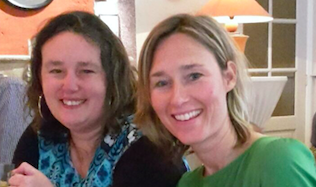
Madelon, Anouk’s sister