What is Myotonic Dystrophy?

The most common muscle disease in the world

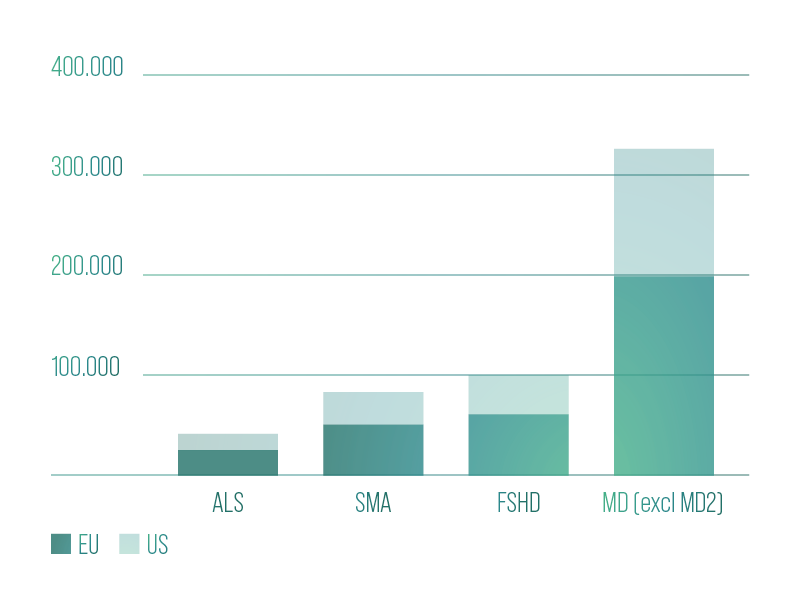
Myotonic Dystrophy (MD) is caused by a genetic defect that has major consequences. Muscle impairment is just one of its manifestations, which means it is actually more of a multi-system disease. As a muscle disease, it is the most common in the world, far more common than a muscle disease like ALS or FSHD and SMA. Recent research shows that, worldwide, 1 in 2,100 people has MD. In real numbers, that’s more than 3.6 million people. At the same time, MD is still very little known, even among doctors.

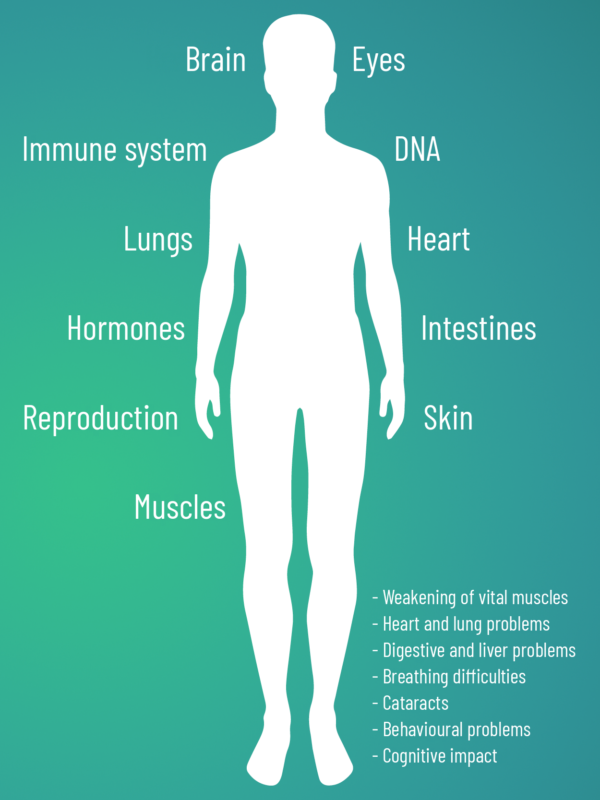
Besides the muscles, Myotonic Dystrophy affects important organs such as the lungs, the brain, and the heart. MD is fatal. There is not yet a cure for MD.

Hereditary and progressive

Myotonic Dystrophy is a serious, progressive, hereditary disease. There is a 50% chance of genetically passing on the gene defect to the next generation, and it then appears in an increasingly severe form. As a result, children in particular are hit the hardest. They themselves have the most severe form, with physical and cognitive impact. In addition, more people in their family also have Myotonic Dystrophy, including at least one parent.

Donate now for more research and a cure

Lack of awareness of Myotonic Dystrophy is the greatest danger

Unpredictable, but “a little less every day” — that’s how one patient describes the course of his disease, in which even the most vital muscles eventually weaken: MD patients are both cardiac and pulmonary patients. Because the problems are caused by a genetic defect, there are many more issues involved: MD patients have stomach and intestinal complaints, often develop cataracts early, and sometimes experience behavioral problems due to the cognitive impact of the disease. Life expectancy for people with MD is significantly shortened and depends largely on when the first symptoms become visible: the earlier it starts, the worse the outlook and the shorter the life expectancy.

Make a donation

The best care

MD is a complex disease involving many more issues than just the muscles. The centers of expertise at Radboudumc in Nijmegen and Maastricht UMC in the Netherlands are well aware of this complexity. As such, these centers complement your local specialists.


Further research requires more data, and only patients themselves can provide this. You can do so by registering in the database. Registration is crucial for the development of therapies and, above all, for ensuring that medicines become available quickly once they have been developed; this can take as much as 5 to 10 years off the time it takes for medication to become available. A database that is as large as possible is therefore vital, so every registration counts.

Find more information about MD on these websites.

MDF is the largest specialized foundation dedicated to MD. This American organization offers a wealth of up-to-date information for patients and researchers. Its annual conference in September is a key event where new research findings are shared with patients and their families.

Myotonic Dystrophy Foundation
Read more about Myotonic Dystrophy Foundation

VSN is the patient association for various muscle diseases in the Netherlands. It provides up-to-date information on managing the effects of MD for patients, family members, and healthcare professionals alike. Membership starts at €24.90 per year. The organization has a highly active group dedicated to providing specific information about MD.

Spierziekten Nederland
Read more about Spierziekten Nederland

Het Spierfonds acts as the financial engine in the fight against all muscle diseases, serving as the driving force behind scientific research and patient support. MD Nederland (later MD Europe) was established in consultation with PBS. MD Europe's initiatives extend beyond scientific research and complement those of PBS.

Prinses Beatrix Spierfonds
Read more about Prinses Beatrix Spierfonds

Frequently asked questions about Myotonic Dystrophy

  • What is MD?

    Myotonic Dystrophy (MD) is a multi-system disease that affects at least 1 in 2,100 people (Johnson 2021). MD is hereditary and is passed down from generation to generation, appearing in an increasingly severe form each time. Although MD is often seen as a muscle disease, its impact is much greater. For example, people with MD can also have heart function abnormalities, breathing difficulties, cataracts, problems with speech and swallowing, cognitive disorders, excessive daytime sleepiness, or diabetic symptoms.

  • Two Types of MD (DM1 and DM2)

    There are two types of MD: myotonic dystrophy type 1 (DM1) and type 2 (DM2).

    DM1 and DM2 are similar in many respects. Both are hereditary muscle disorders characterized by symptoms such as muscle weakness and muscle stiffness, combined with issues affecting the heart, respiratory system, gastrointestinal tract, eyes, and hormonal system.

    However, there are also differences. DM1 occurs more frequently, often begins at a younger age, and can follow a more severe course; it may also manifest earlier and more severely with each successive generation. This results in different forms of DM1 that present in various ways.

    In DM2, these distinct forms are not clearly apparent. DM2 typically does not manifest symptoms until adulthood and often follows a slower progression. The pattern of muscle weakness also differs: in DM2, the hips, thighs, and shoulders are more frequently affected, whereas in DM1, the face, hands, and lower legs are more commonly involved. Furthermore, muscle pain is often a more prominent feature in DM2.

  • Four forms of DM1 and their symptoms

    There are four forms of myotonic dystrophy type 1 that manifest in different ways:

    • The mild form, with slight muscle weakness and cataracts of the eye lens
    • The classic form, with slowly increasing muscle weakness in the face, jaw, throat, and neck muscles, and in the arms and legs
    • The more severe childhood form, with accompanying delayed intellectual development, speech problems, and muscle weakness
    • The most severe form, in babies: the congenital form.

  • How common is MD?

    MD is the most common muscle disease in the world. Recent research indicates that an estimated 1 in 2,100 people worldwide has MD. This translates to more than 3.6 million people (Johnson 2021). Prevalence rates can vary significantly by country and region.

  • Is MD hereditary?

    Yes. Every child of a parent with myotonic dystrophy has a 50% chance of also having the disease.

    The MD gene (the hereditary factor for myotonic dystrophy) is located on chromosome 19 (DM1) of chromosome 3 (DM2). If the disease runs in your family and you wish to start a family, it is advisable to seek expert advice from a clinical genetics center in good time. This is also important if you yourself show few or no symptoms of the disease (as yet).

  • What is the impact of MD?

    On the body

    MD is a multisystem disease that affects the entire body. Because the problems stem from a genetic defect, the impact of MD extends far beyond the muscles alone: ​​MD patients often suffer from heart and lung conditions, as well as gastrointestinal and liver issues. Other characteristic features include cataracts at an early age, speech and swallowing difficulties, diabetes, hormonal imbalances, gallbladder problems, a flat facial expression, excessive daytime sleepiness, and cognitive impairments.

    Impact on families

    MD has a huge impact on families, with children being the hardest hit: they have the most severe form. Moreover, at least one of the parents and grandparents also has MD, as do siblings in many cases.

    Societal issue

    MD causes immense social challenges for both those affected by the condition and their informal caregivers. The complications associated with MD directly impact the daily lives of affected families; the numerous physical—and sometimes mental—limitations often leave families socially isolated to varying degrees, frequently confining them to the home. Furthermore, family members who do not have MD often find themselves shouldering increasingly heavy caregiving responsibilities—tasks that frequently involve caring for not just one, but multiple family members.

  • Why is awareness for MD so important?

    Due to a lack of awareness regarding MD, the disease often goes unrecognised—not only by those who have it but also by doctors. This means that MD is frequently passed on unknowingly to the next generation, often in a more severe form. Furthermore, affected individuals fail to receive appropriate care, such as cardiac monitoring and the necessary precautions during surgery (anaesthesia can be fatal for people with MD).

  • Can the transmission of MD be prevented?

    MD can only be prevented through prenatal screening. Pre-implantation genetic diagnosis (PGD) is an option. With PGD, egg cells are fertilised and examined outside the womb. An embryo without the genetic predisposition is then placed in the womb. https://www.healthcouncil.nl/documents/2023/11/15/preconception-carrier-screening. Another option is prenatal diagnosis. Prenatal diagnosis involves testing during pregnancy to determine whether or not the unborn child has a specific congenital condition.

    The diagnostic tests involved are chorionic villus sampling, amniocentesis, and detailed ultrasound examination. It is important to discuss this with the doctor in time, as some tests are no longer possible after a certain number of weeks and the procedures themselves take time.https://www.pns.nl/en/multiple-languages/english

  • Is there medication for MD?

    No, there is not yet a solution for MD. What is hopeful, however, is that the cause of MD is known and there are promising scientific developments underway toward a medication. More than 100 years after the discovery of MD, there is a possibility that the first medication will reach the market in the coming years.

Donate directly